



AI for Early Treatment Response Assessment in Hodgkin Lymphoma
PI-Technion, Assoc. Prof. Moti Freiman PI-Rambam, Dr. Anat Ilivitzki, MD
A joint Technion–Rambam project developing an AI-based platform to analyze longitudinal PET-CT scans and improve prediction of treatment response in Hodgkin lymphoma. By moving beyond conventional visual and semi-quantitative interpretation, the project aims to support earlier, more objective, and more personalized clinical decision-making. Why It Matters In Hodgkin lymphoma, early assessment of treatment response is critical. Current PET-CT evaluation methods are valuable, but they remain limited by subjectivity, inter-reader variability, and incomplete characterization of tumor heterogeneity. This can delay treatment adaptation and expose patients to unnecessary toxicity or ineffective therapy.
Our AI Approach
Using retrospective data obtained from Rambam Health Care Campus, the project combines longitudinal radiomics and machine learning to extract clinically meaningful information from PET-CT scans acquired over time. Instead of relying only on single-timepoint imaging markers, the platform analyzes temporal changes in tumor phenotype to generate more robust response predictions.
Core capabilities include:
- Longitudinal PET-CT data processing
- Region-of-interest annotation and feature extraction
- Machine-learning model development for response prediction
- Clinical deployment through a hospital-ready software platform
Research Goals
- Build a clinically deployable longitudinal radiomics software platform
- Develop and validate AI models for therapy response prediction in Hodgkin lymphoma
- Create curated PET-CT datasets with expert annotations and clinical outcomes
- Demonstrate added value over current imaging-based assessment workflows
Progress to Date
The team has already developed a Python-based longitudinal radiomics framework and demonstrated its value in predicting treatment response in breast cancer, where it achieved leading performance in an international challenge. The platform has since been extended toward PET-CT oncology applications, including Hodgkin lymphoma.
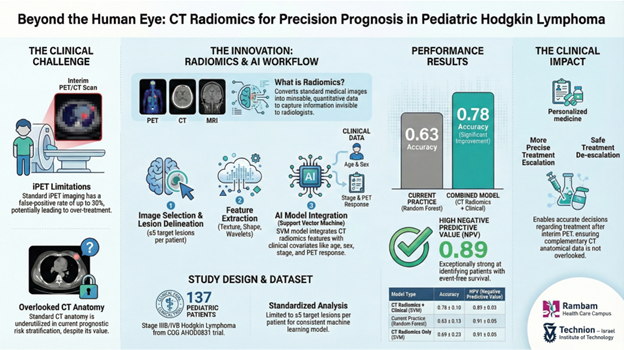
Recent work also showed that CT radiomics adds complementary prognostic value beyond PET and clinical parameters alone in pediatric Hodgkin lymphoma.
Impact
This project advances a scalable AI framework for precision oncology imaging, with potential applications beyond Hodgkin lymphoma to additional cancer types, clinical workflows, and drug-development settings.
Scientific Visibility
Presented at:
- ISRA – Israel Radiological Association Annual Meeting 2025
- European Congress of Radiology (ECR) 2026
Selected Publications
- Ibrahim L. et al., CT Radiomics for Prognostic Prediction of Outcome in Pediatric Hodgkin Lymphoma, presented at ISRA 2025.(opens in new tab)
Funding Acknowledgment
This research is supported by the Israel Innovation Authority (IIA), Kamin No. 80783/4 as part of a collaborative program between the Technion – Israel Institute of Technology and Rambam Health Care Campus.