




Advancing Research and Practice in Suicide Prevention Through Artificial Intelligence
PI-Technion, Prof. Roi Reichart, PhD, PI-Rambam, Prof. Eyal Fruchter, MD
Suicide prevention remains one of the most urgent challenges in global mental health. Recent advances in artificial intelligence (AI) and natural language processing (NLP) offer new opportunities to detect early warning signs of psychological distress and to better understand the mechanisms underlying suicidal behavior. Our research program focuses on integrating computational methods with clinical knowledge to improve the identification, understanding, and prevention of suicide risk. Our work combines large-scale digital data with insights from psychology and psychiatry to uncover behavioral and linguistic markers associated with suicide risk.

By analyzing longitudinal patterns in online activity and language use, and by combining naturally occurring (“organic”) data from social media platforms (including WhatsApp) with clinical datasets, we aim to identify signals that may precede suicidal crises and provide actionable insights for clinicians and mental health researchers.
A central goal of our research is to bridge the gap between computational innovation and clinical practice. Rather than treating AI models as purely predictive tools, we seek to develop interpretable systems that reveal meaningful psychological mechanisms and can be integrated into real-world mental health settings. This includes studying how online environments reflect mental health trajectories and exploring how digital platforms may offer new opportunities for early identification and intervention.
Our recent work includes identifying boredom as a previously underrecognized mechanism associated with suicidal behavior through AI-driven analysis, as well as developing longitudinal large language model (LLM) approaches to study suicidality as expressed in YouTube content. These studies illustrate how computational approaches can reveal behavioral patterns that are difficult to capture through traditional clinical methods alone.
In our current work, funded by a Kamin grant from the Israel Innovation Authority, we are collecting data from the Rambam mental health clinic alongside a very large sample from Israel’s general population. The goal of this research is to validate our previous results in a large-scale general population study and extend the scope of our methodology to clinical populations. We believe this is a key step in making our research ready to become a practical technology for suicide prevention and risk factor identification.
A key strength of this research lies in the long-standing collaboration between the Technion NLP Lab in the faculty of Data and Decision Sciences, led by Prof. Roi Reichart(opens in new tab), and leading clinical experts in psychiatry, including Prof. Eyal Fruchter and Dr. Haya Vechtel. This interdisciplinary partnership enables a unique integration of computational innovation with clinical expertise, ensuring that the research remains closely aligned with real-world psychiatric needs while expanding the possibilities for AI-driven insights in suicide prevention.
More broadly, this work contributes to the emerging field of computational mental health, where interdisciplinary collaboration between data scientists, psychologists, psychiatrists, and clinicians enables the development of responsible and clinically grounded AI tools for mental health care.
-
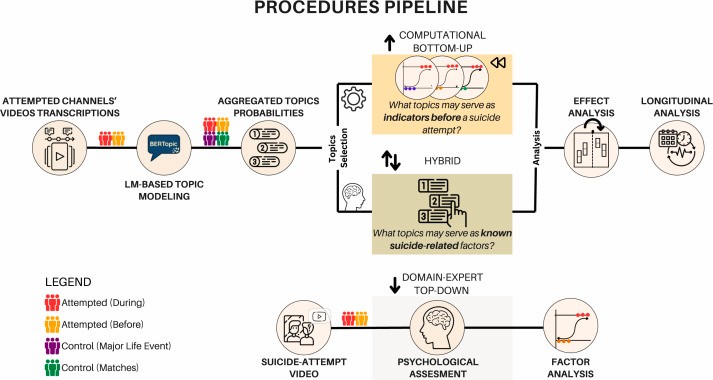
- Figure1. adapted from Sobol, I., et al. (2026), Journal of Affective Disorders.
-
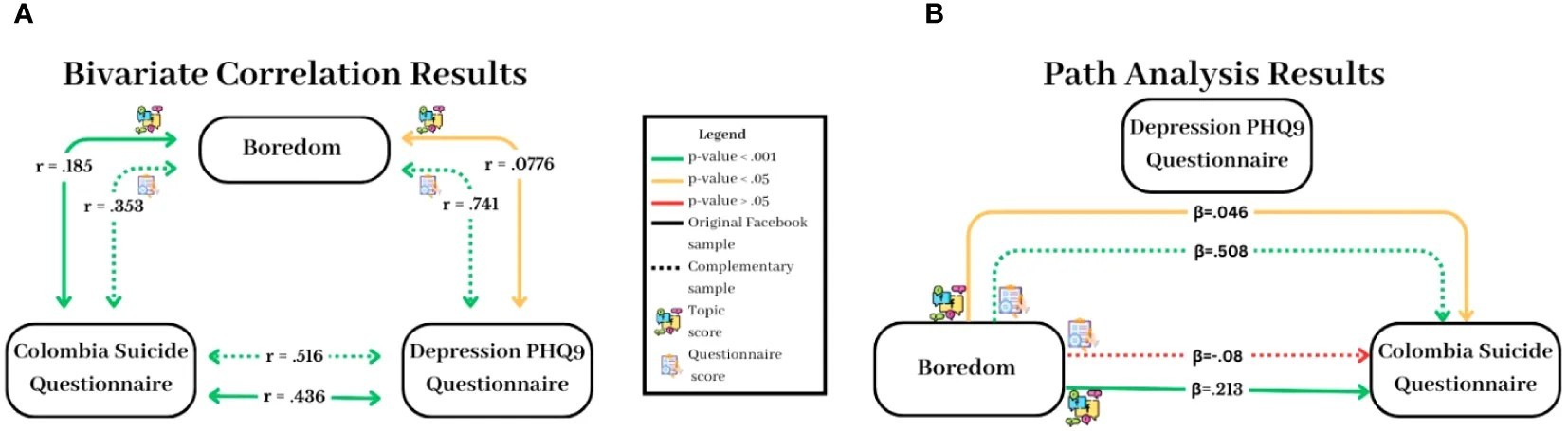
- Figure2. adapted from Lissak, S., et al. (2024), Front. Psychiatry.
These works were published in top-tier psychiatric journals
- Lissak, S., Ophir, Y., Tikochinski, R., Brunstein Klomek, A., Sisso, I., Fruchter, E., & Reichart, R. (2024). Bored to death: Artificial intelligence research reveals the role of boredom in suicide behavior. Frontiers in Psychiatry, 15, 1328122. https://doi.org/10.3389/fpsyt.2024.1328122(opens in new tab)
- Sobol, I., Lissak, S., Tikochinski, R., Nakash, T., Brunstein Klomek, A., Fruchter, E., & Reichart, R. (2026). Bridging online behavior and clinical insight: A longitudinal LLM-based study of suicidality on YouTube reveals novel digital markers. Journal of Affective Disorders, 400, 121072. https://doi.org/10.1016/j.jad.2025.121072(opens in new tab)
- Tikochinski, R., Goldstein, A., Meiri, Y., Hasson, U., & Reichart, R. (2025). Incremental accumulation of linguistic context in artificial and biological neural networks. Nature Communications, 16(1), 803. https://doi.org/10.1038/s41467-025-56162-9(opens in new tab)
- Goldstein, A., Grinstein-Dabush, A., Schain, M., Wang, H., Hong, Z., Aubrey, B., Nastase, S. A., Zada, Z., Ham, E., Feder, A., Gazula, H., Buchnik, E., Doyle, W., Devore, S., Dugan, P., Reichart, R., Friedman, D., Brenner, M., Hassidim, A., Devinsky, O., Flinker, A., & Hasson, U. (2024). Author correction: Alignment of brain embeddings and artificial contextual embeddings in natural language points to common geometric patterns. Nature Communications, 15(1), 8500. http://dx.doi.org/10.1101/2022.03.01.482586(opens in new tab)