


k-SPARK: Ultra-fast AI-powered brain MRI for aging and neurodegenerative disease
PI-Israel, Assist. Prof. Efrat Shimron, PhD, Technion,
PI-France, Prof. Philippe Ciuciu, PhD, CEA / NeuroSpin
Research Team
Dr. Ayellet Eran, MD, Rambam,
Dr. Dafna Link-Sourani, PhD, May-Blum-Dahl Technion Human MRI research center,
Dr. Chaithya Giliyar Radharkishna, PhD, CEA / NeuroSpin, France,
Prof. Blanche Bapst, MD, Henri Mondor University Hospital, France
The clinical problem Magnetic Resonance Imaging (MRI) is a cornerstone of modern medicine, providing detailed, non-invasive views of the brain that are essential for diagnosing and monitoring neurological conditions, such as Alzheimer’s disease, Parkinson’s disease, and other forms of dementia. Each year, millions of brain MRI scans are performed worldwide, playing a critical role in clinical decision-making and patient care. However, MRI examinations are inherently time-consuming. A typical brain scan consists of multiple imaging sequences, each lasting several minutes, leading to total scan times that can extend to 30–60 minutes. These long durations place a significant burden on patients and clinical workflows, and often result in incomplete or unusable scans that must be repeated.
Reducing scan time, while preserving the high image quality required for clinical use, is therefore a central challenge in modern MRI. Addressing this challenge has the potential to improve patient experience, increase the reliability of scans, and enable more efficient and accessible brain imaging in clinical practice.
Addressing the challenge using Artificial Intelligence
This research aims to substantially reduce scan time in brain MRI by combining artificial intelligence (AI) with advanced MRI acquisition methods, enabling faster data acquisition and reconstruction of high-quality images from shorter scans.
This project is a collaboration between Technion–Rambam–and CEA, a French government-funded research organization in Paris. It integrates SPARKLING, an efficient MRI data acquisition method developed at CEA, with k-band, a self-supervised AI-based reconstruction framework developed at the Technion; this project is hence titled k-SPARK.
The project aims to reduce the length of high-quality brain MRI scans from 8-9 minutes to under one minute, even when only partial data is acquired, and hence making MRI more accessible and efficient.
The approach includes:
- Faster and more efficient data acquisition, implemented directly on MRI scanner.
- AI-based reconstruction that restores high-quality images from limited data.
- Joint development and validation across Technion and CEA/NeuroSpin.
T1-weighted brain images acquired at the Technion MRI Center
Research goals
- Enable under-one-minute T1-weighted brain MRI scans.
- Integrate advanced MRI data acquisition strategies with AI-based reconstruction.
- Ensure robustness and generalization across sites and scanners, including 3T and 7T MRI systems.
- Advance clinical usability for aging populations.
Research achievements
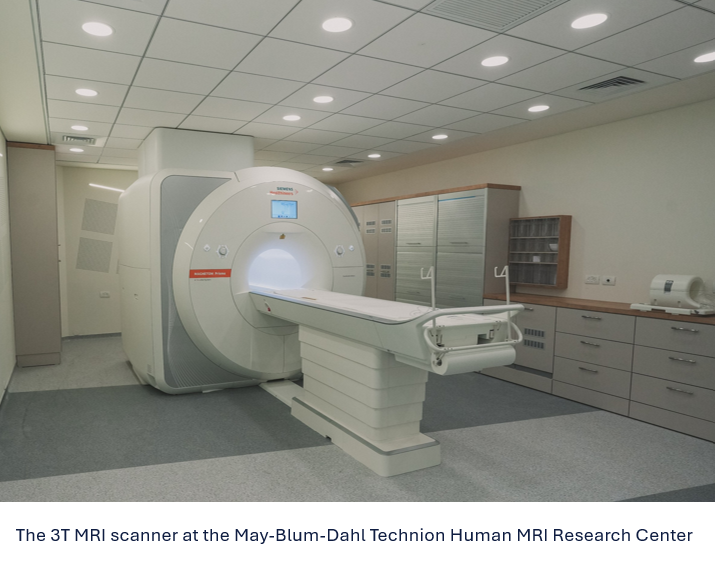
- Successful deployment of SPARKLING acquisition on a 3T MRI scanner at the May-Blum-Dahl Technion Human MRI Research Center(opens in new tab), and deployment of the k-SPARK framework at both sites – Technion and CEA/NeuroSpin.
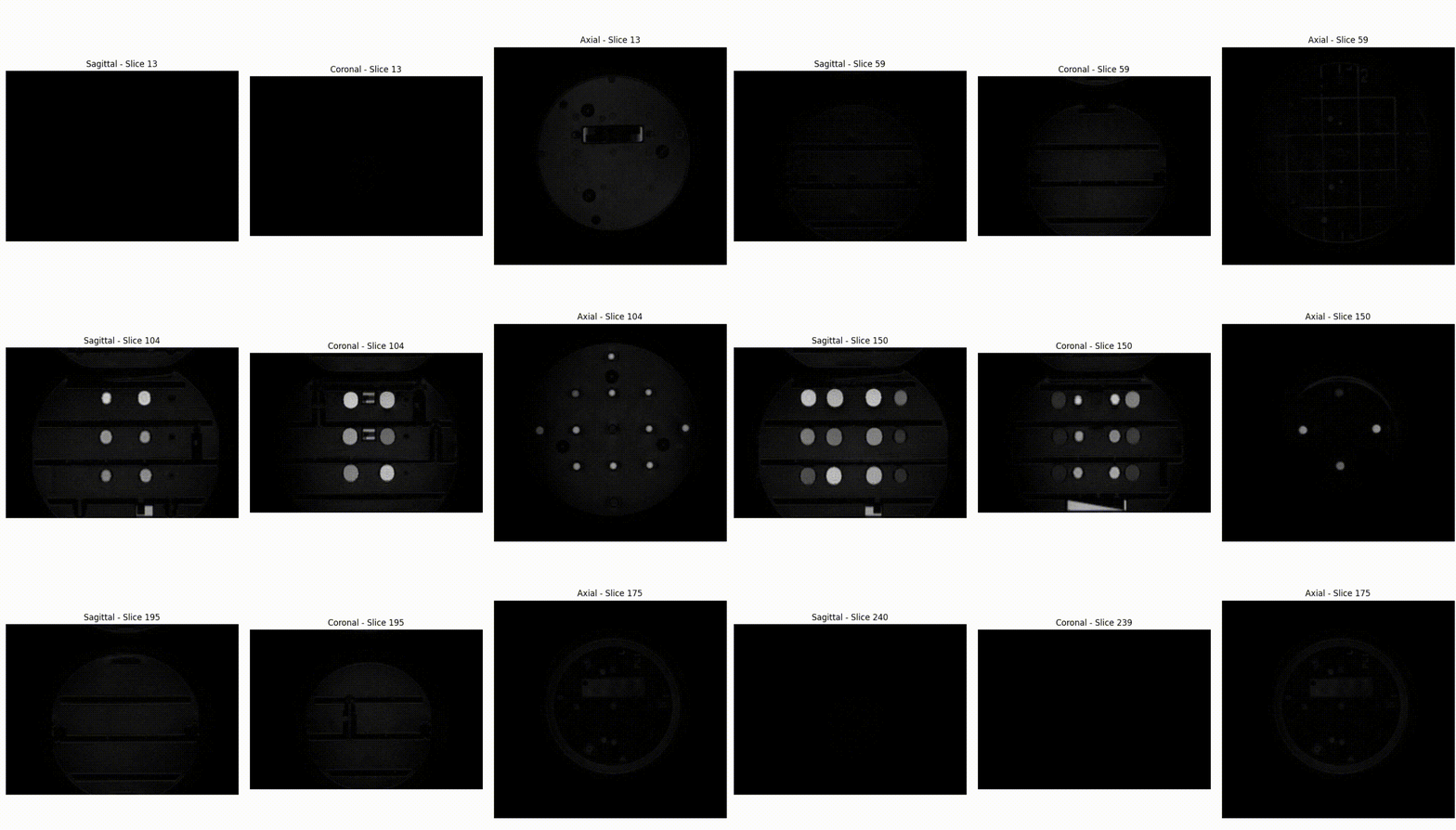
- First phantom scans and initial AI-based reconstructions.
- Establishment of a stable joint workflow, including shared code and coordinated experiments.
Impact
- Faster and more robust MRI for elderly and less cooperative patients.
- Reduced scan times and improved clinical workflow.
- Increased MRI accessibility and throughput.
- Foundation for large-scale studies of brain aging.
NIST phantom scan acquired at the Technion using the implemented sequence with dedicated reconstruction
Publications