




Fusing mechanistic and data-driven models for decision making in dynamic environments (real-time information on the patient’s cardiovascular status, expected trajectory and underlying disease processes)
Assoc. Prof. Danny Eytan, MD, PhD, Rambam,Prof. Shie Mannor, PhD, Technion, Prof. Uri Shalit, PhD Technion
Intensive care produces a continuous stream of physiological data, yet the variables clinicians actually reason about — cardiac output, vascular resistance, filling pressures — remain hidden and must be inferred from noisy, partial signals using experience-based mental models. Coupling mechanistic, biophysics-grounded models with data-driven AI resolves weaknesses that neither approach overcomes alone, and is the shared methodological foundation behind this project and several others in the group.

Why Hybrid Modeling
Purely mechanistic models — systems of differential equations describing the heart and circulation — are interpretable and physiologically grounded, but the inverse problem of fitting them to a real patient is frequently non-identifiable from routine bedside measurements. Prior work has coped by fixing parameters to “typical subject” values, which fails in heterogeneous populations and especially in pediatrics, where body size and normative ranges vary markedly. Commercial pulse-contour tools for cardiac output, calibrated on adults, illustrate the failure mode: they generalize poorly to children. Purely data-driven models sit at the opposite extreme — flexible and accurate in-distribution, but they degrade sharply once a patient’s physiology drifts outside the training data, which is precisely the regime critically ill patients occupy.
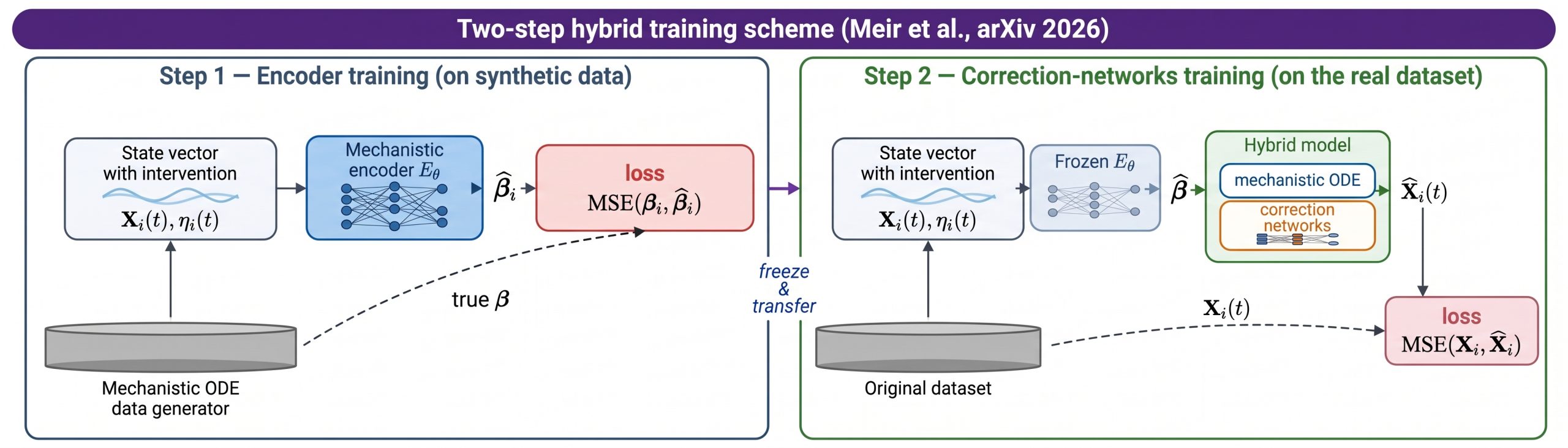
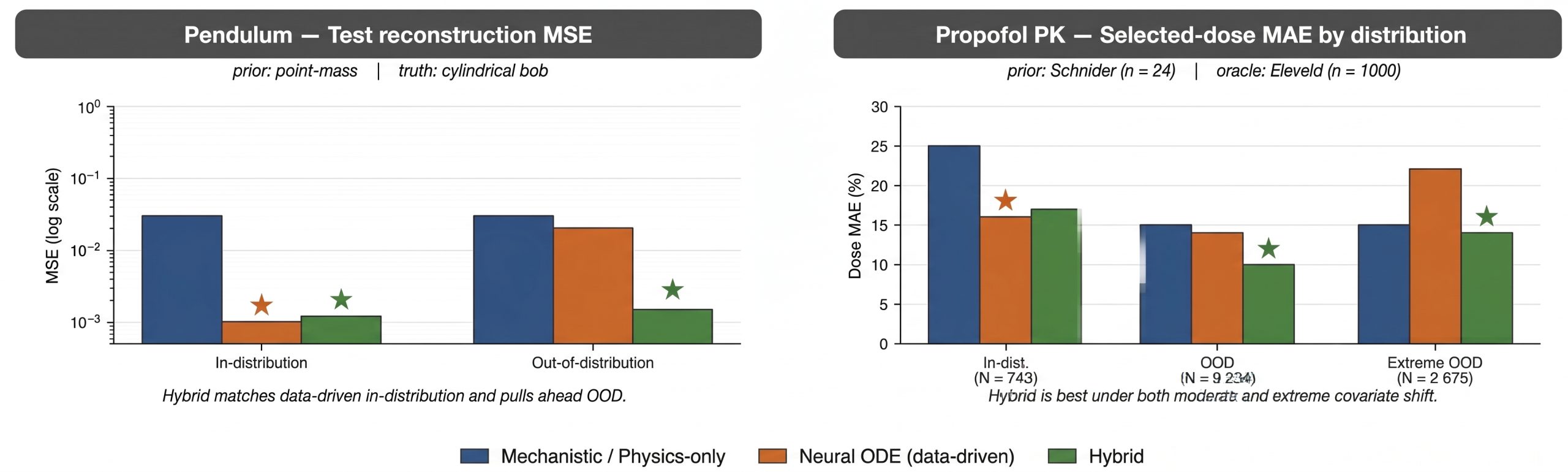
Hybrid, biophysics-informed AI couples a differentiable mechanistic core with learned neural components that correct only what the equations cannot explain: the physics constrains the solution space and preserves interpretability and robustness under sparse data, while the learned residual captures patient-specific dynamics — pericardial effects, capillary-leak dynamics, pharmacologic idiosyncrasies — that a hand-built model would miss. Benchmarked on a controlled pendulum-with-intervention task and a clinical pharmacokinetics task, this structured hybrid approach matches purely data-driven accuracy in-distribution while remaining far more robust out-of-distribution.
The Cardiovascular Digital Twin
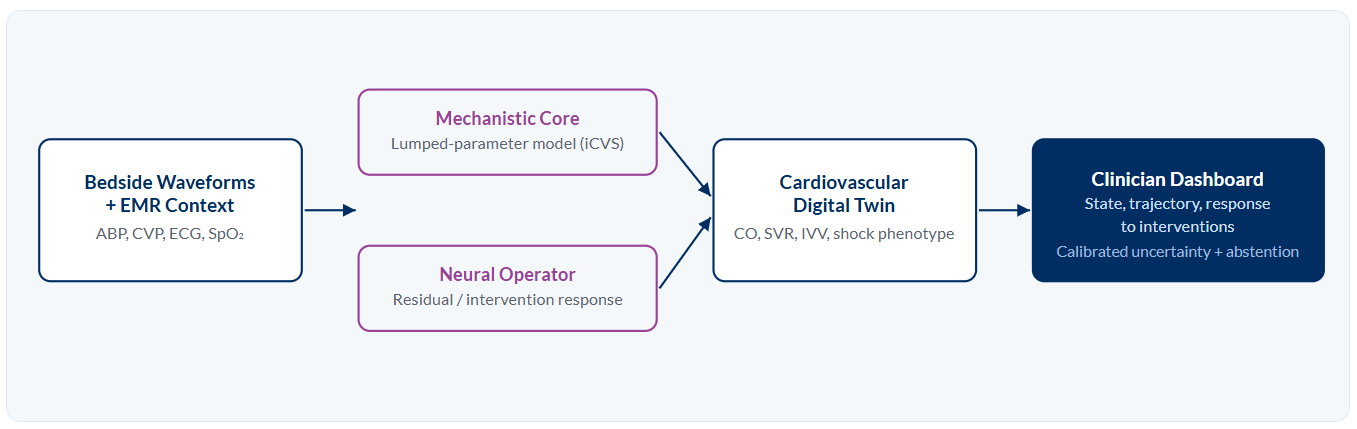
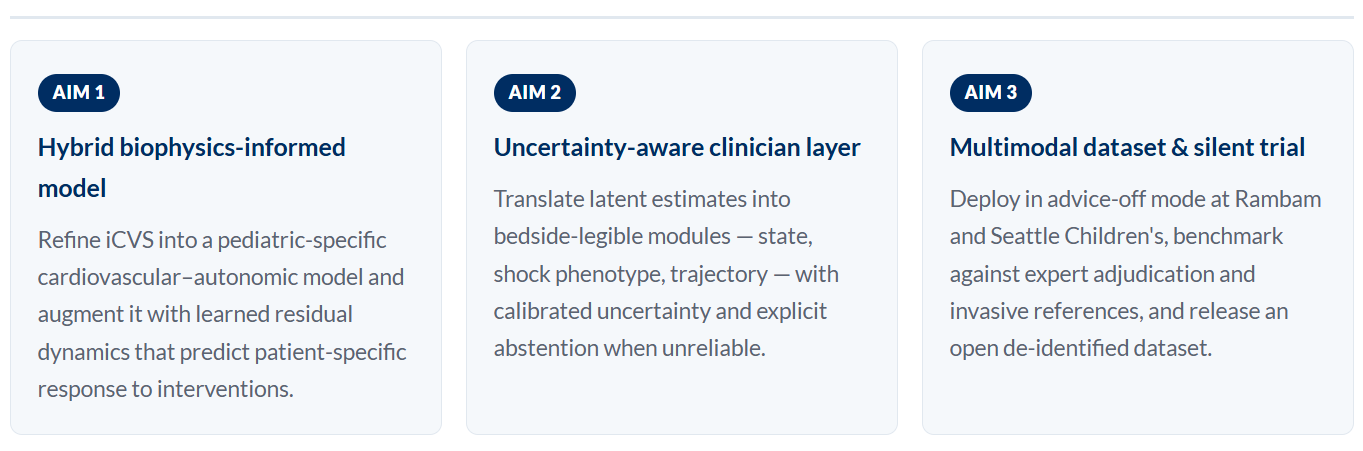
Critically ill children deteriorate as cardiovascular status shifts — hypovolemic, cardiogenic or distributive shock — yet cardiac output, systemic vascular resistance and filling pressures cannot be measured continuously at the bedside. This project instantiates the hybrid paradigm above as a deployable cardiovascular digital twin: a differentiable lumped-parameter cardiovascular model coupled to learned neural operators that capture patient-specific residual dynamics, inferring latent hemodynamic state in real time from signals already on the monitor and simulating a patient’s response to treatment before it is given. Outputs are translated into a clinician-facing layer with calibrated uncertainty and explicit abstention when confidence is low, then validated in a silent, advice-off prospective trial at two tertiary pediatric ICUs.
Preliminary Evidence
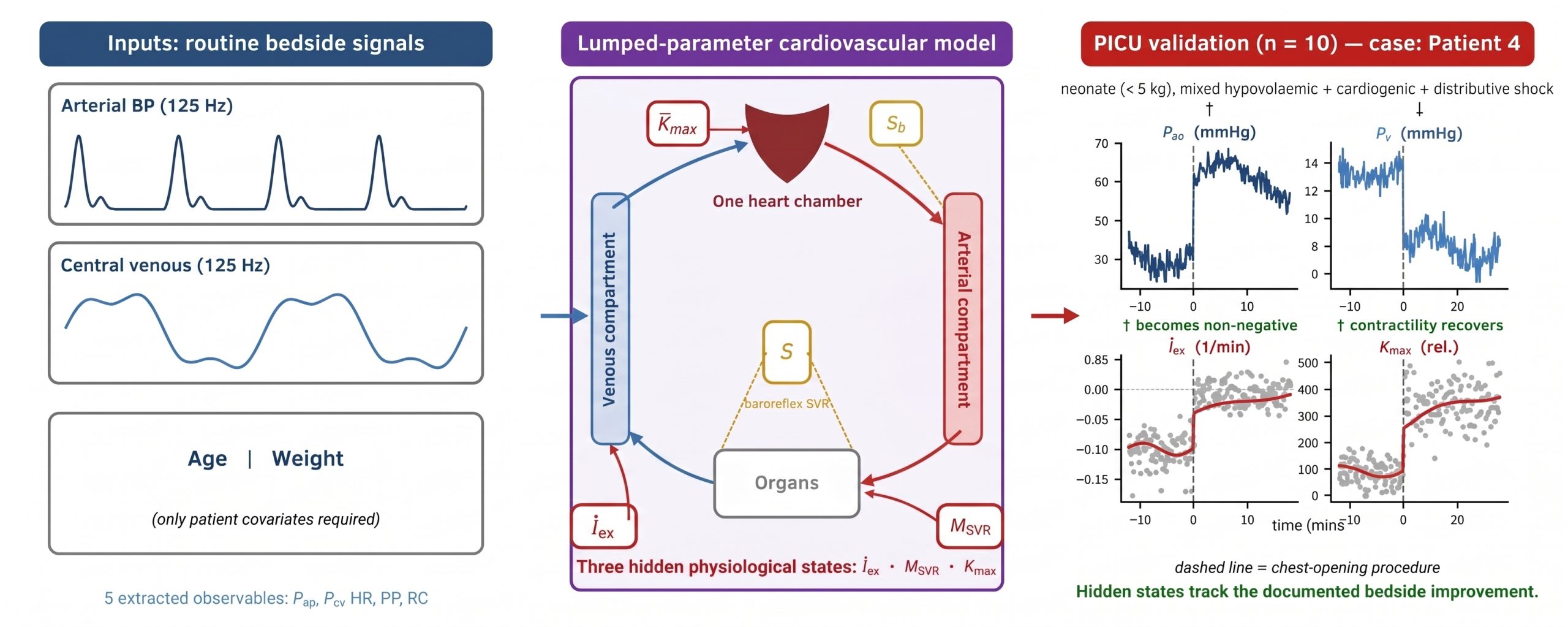
The team’s published iCVS model already infers hidden cardiovascular states in real time from routine arterial and venous pressure waveforms plus age and weight alone. In a cohort of ten critically ill children, it reconstructed observed signals with Pearson r = 0.95–0.99 and tracked a documented bedside improvement in a neonate with mixed shock after a chest-opening procedure.
A companion architecture study shows why the hybrid approach is needed: a purely data-driven model wins in-distribution but degrades sharply under covariate shift, while the hybrid mechanistic–neural model stays close to the data-driven model in-distribution and remains far more robust out-of-distribution — the exact regime critically ill patients occupy.
 |
 |
Specific Aims
Part of a Broader Hybrid-Modeling Program
The digital twin draws on and feeds into a wider TERA effort applying hybrid mechanistic–AI modeling across critical care: individualized, uncertainty-aware dosing dynamics via neural eigen decomposition; variational learning of cardiovascular systems with unmeasured “known-unknowns”; and self-supervised representations for irregular physiological time series. The physics-informed losses, neural operators and structured two-stage training developed here are shared methodological foundations, applied jointly across multiple organ systems and clinical contexts rather than built in isolation for this project alone.
Why It Matters
This shifts pediatric critical care from subjective, experience-based inference toward biophysically grounded, patient-specific situational awareness. Because the trial runs advice-off — inferences are logged but never shown at the point of care — validation carries minimal risk while still testing the system against real-world data at two independent sites. The architecture is designed to extend naturally to other physiological systems and to adult critical care.
Key Publications:
- Meir, T., Linial, O., Eytan, D., & Shalit, U. (2026). Structured hybrid mechanistic models for robust estimation of time-dependent intervention outcomes.
https://doi.org/10.48550/arXiv.2602.11350 - Ravid Tannenbaum, N., Gottesman, O., Assadi, A., Mazwi, M., Shalit, U., & Eytan, D. (2023). iCVS—Inferring cardio-vascular hidden states from physiological signals available at the bedside. PLOS Computational Biology, 19(9), e1010835. https://doi.org/10.1371/journal.pcbi.1010835(opens in new tab)
- Ehrmann, D. E., Joshi, S., Goodfellow, S. D., Mazwi, M. L., & Eytan, D. (2023). Making machine learning matter to clinicians: Model actionability in medical decision-making. npj Digital Medicine, 6(1), 7. https://doi.org/10.1038/s41746-023-00753-7(opens in new tab)
- Azriel, R., Hahn, C. D., De Cooman, T., Van Huffel, S., Payne, E. T., McBain, K. L., Eytan, D., & Behar, J. A. (2022). Machine learning to support triage of children at risk for epileptic seizures in the pediatric intensive care unit. Physiological Measurement, 43(9). https://doi.org/10.1088/1361-6579/ac8ccd(opens in new tab)
- Eini-Porat, B., Amir, O., Eytan, D., & Shalit, U. (2022). Tell me something interesting: Clinical utility of machine learning prediction models in the ICU. Journal of Biomedical Informatics, 132, 104107. https://doi.org/10.1016/j.jbi.2022.104107(opens in new tab)
Conference Proceedings & Presentations:
- Eini-Porat, B., Eytan, D., & Shalit, U. (2024). Aiming for relevance. AMIA Joint Summits on Translational Science Proceedings, 2024, 145–154. https://pmc.ncbi.nlm.nih.gov/articles/PMC11141809/
- Belogolovsky, S., Greenberg, I., Eytan, D., & Mannor, S. (2023). Individualized dosing dynamics via neural eigen decomposition. Advances in Neural Information Processing Systems, 36, 56211–56233. https://doi.org/10.48550/arXiv.2306.14020(opens in new tab)
- Eytan, D. (2024). The (yet to be fulfilled) potential of rich physiological datasets. Presented at the PEDS Cardio AI Conference, Austin, TX, USA.